
Strategy · Guide · 5 MIN READ
Drowning in Text: Why the Perfect Spec Fails Against Reality
A hundred-and-fifty-page requirements spec, worked through cleanly — and the finished software fails on its first day on the shop floor. Why text is a lossy medium for operational knowledge, and how we close the gap between paper and practice.
strukturunion Team · July 16, 2024
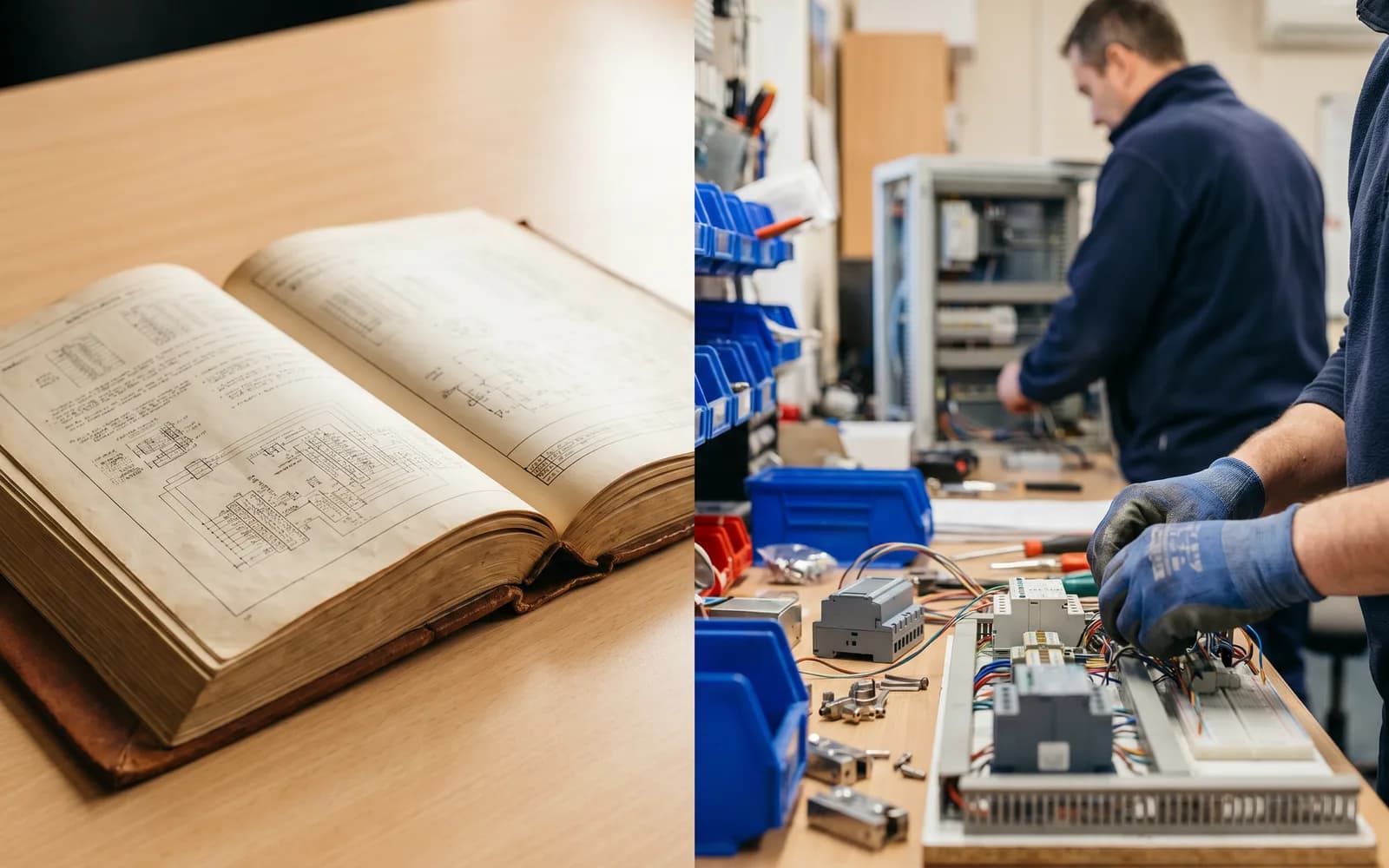
A project lead wants to bring a complex software integration under control and writes a requirements spec of a hundred and fifty pages. He hands it off to a remote development team. After months of quiet work, the team delivers software that matches the written word exactly — and fails completely in real operation on the shop floor. Every requirement met, and yet unusable.
The pattern
Written text is a surprisingly lossy medium for transferring operational knowledge. A developer sitting far away cannot hear the ambient noise out of a document, cannot see the oil on the operators' hands, cannot feel the network connection dropping on the production line, and certainly cannot know the unwritten tricks that actually keep everyday work running.
None of it appears in any requirements spec, because it strikes no one as worth mentioning — it is simply the reality in which people work. That is exactly where the trap lies. Anyone who relies on the exchange of documents alone inevitably gets an idealized system: one that works in the tidy world of text and breaks the moment it meets the messy, physical conditions of real work. The specification does not describe the shop floor, but a clean idea of it. And what gets built follows the idea.
From our practice
As a small core team of just a few people, we see ourselves precisely as the translation layer between paper and practice. When we work with larger in-house IT departments or external development partners, we don't just pass static specifications along. We tie the abstract code back to the actual physical conditions of the shop floor.
In practice, that looks like this:
- An on-site prototype instead of a document from afar. Within a few days we build a minimal, working view of the interface — right in the environment where it will later be used.
- Capture reality. We film the operators on the line, document the noise, the routes, the interruptions — everything a requirements spec never captures.
- Tight, fast alignment. Instead of months of silent development, we hold short, frequent feedback rounds with the people who will use the system.
This is how we bridge the distance where documents alone fail. The decisive difference: feedback doesn't arrive at the end as a nasty surprise, but from the very start and continuously. A misunderstanding caught in the first week's prototype costs one adjustment. The same misunderstanding, discovered at delivery months later, costs the project.
What this does not mean
It does not mean specifications are pointless. A shared, recorded understanding matters — as memory, as a basis for decisions, as evidence. What doesn't hold is the notion that a document can replace the encounter with reality. The paper records what was agreed. The on-site prototype tests whether what was agreed holds up on the shop floor at all. The two belong together, but the order is decisive: first contact with practice, then the words that record it — not the other way around.
Takeaway
The perfect specification is no guarantee of usable software, only of software that matches the paper. Operational knowledge lives on the shop floor, not in the document — and it can only be captured where the work happens. Showing a prototype early and on-site finds the gap between text and practice while it is still small. If you're about to hand a large software project off to a remote team, we're happy to look at how you can bring the reality of the shop floor to the table.