
CASE STUDY
Legacy ERP bridge for a precision-optics manufacturer
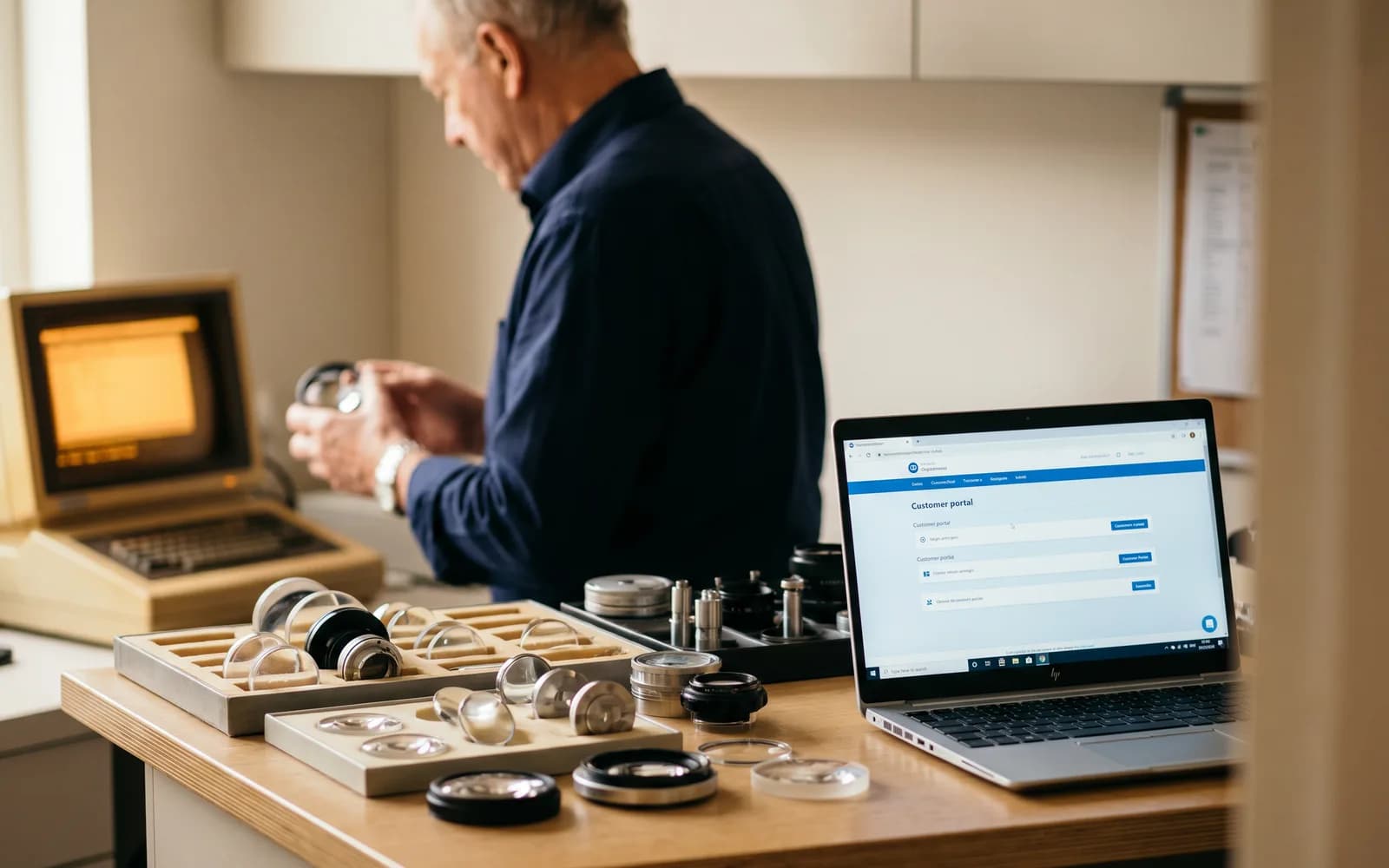
A modern customer portal on top of a closed flat-file system — without touching production's well-drilled terminal workflows. The data bridge syncs in the background.
INDUSTRY
Precision-optics manufacturer
SERVICES
Workflow Integration, Custom Web App, Cloud Deployment
TIMEFRAME
2013 · 4 months
/01
The situation
A maker of high-precision lenses wanted to offer international customers in medical and aerospace engineering modern, browser-based delivery tracking and configuration confirmation. But the critical operating and configuration data sat in an old, closed flat-file database system that had no network interfaces or web connectivity whatsoever.
The internal administrative and production staff were lightning-fast with the existing text-based terminal interface. Key sequences drilled over years let them enter complex lens recipe values in seconds — entirely without a mouse. Management's original plan to replace the complete software ecosystem threatened massive friction, months of slowdown and considerable licensing costs.
/02
Our approach
We built a pure data bridge that fully shielded the internal production team from any change. The experienced technicians kept their familiar terminal interface and their memorized key sequences without a single change — while, in parallel, the external contacts got a modern, clear web view fed by an automatic background sync.
As a solo engagement, we developed a secure, read-only extraction daemon that ran directly on the host server. Every five minutes it performed incremental delta scans of the binary flat files, serialized new records and transferred them to a cloud-hosted relational database. We wrapped this cloud database with a modern, hardened customer portal built on established open-source web frameworks.
/03
The outcome
International customers now tracked their order status independently through the portal; the number of customer-service enquiries dropped noticeably. Production noticed none of it.
Internal entry speed stayed at its historic peak, completely unaffected by the new system. The case showed that modern, outward-facing capabilities can be built without destroying highly efficient legacy workflows on the inside.
YOUR PROJECT