
CASE STUDY
AI document assistant for the technical field service
A tightly bounded AI assistant searches four decades of technical documentation and always shows the exact original page — diagnosis time in the field dropped from around 45 minutes to under half a minute.
INDUSTRY
Agricultural machinery
SERVICES
AI & Automation, RAG Knowledge Search, Custom Web App
TIMEFRAME
2023–2024 · 10 months
/01
The situation
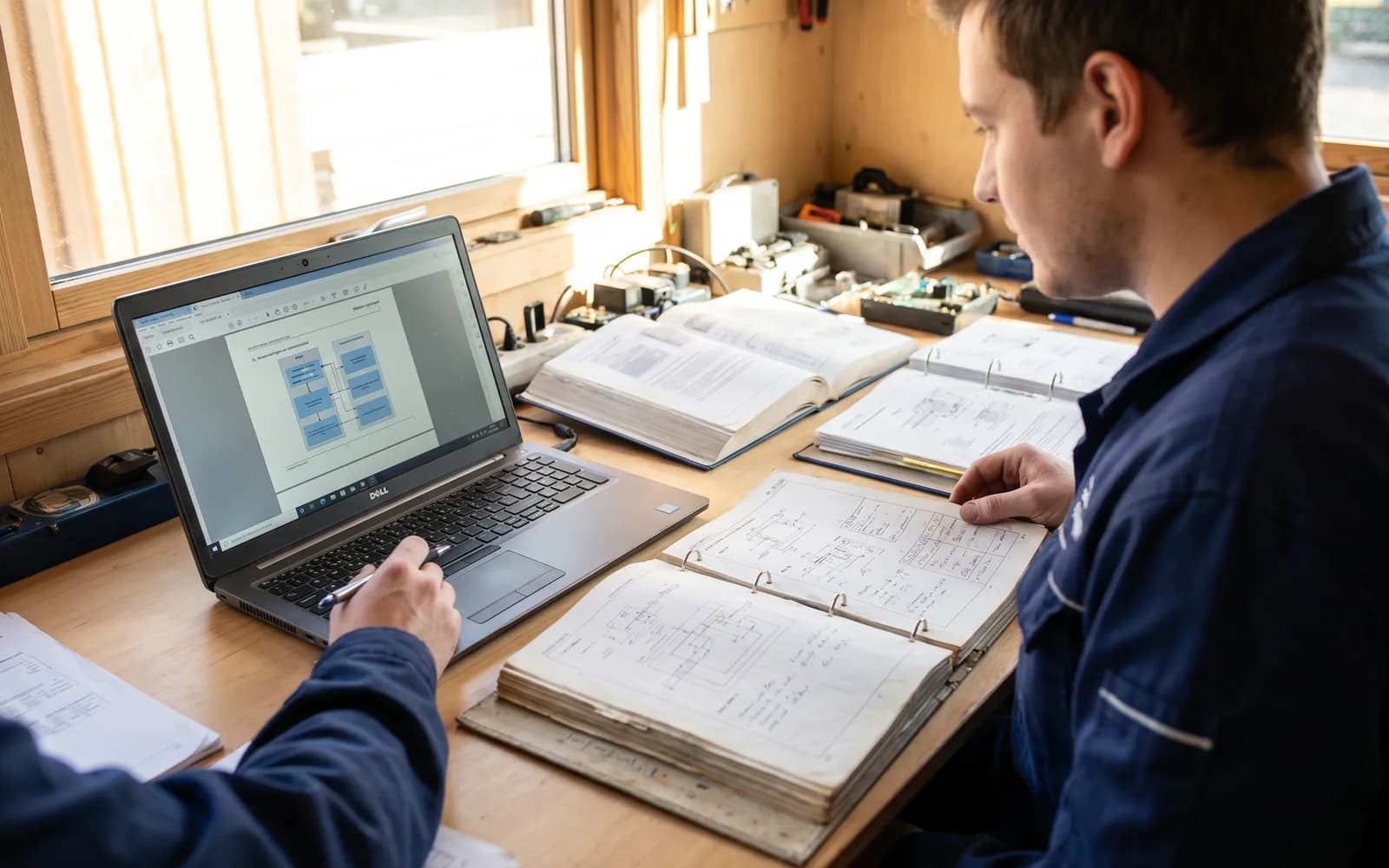
Field-service maintenance technicians at an agricultural-machinery group were losing too much time diagnosing complex harvesters. The company held over four decades of detailed technical documentation — blueprints, component revisions, service bulletins — but these materials lay scattered across countless unindexed PDF files and scanned wiring diagrams.
The experienced mechanics trusted the original, physical service manuals and deeply distrusted modern search software, which often returned irrelevant hits or ignored subtle model-year variants. They preferred manually cross-reading multi-volume paper binders — accurate, but slow and a risk during the critical harvest season.
/02
Our approach
We built a tightly bounded AI research assistant that doesn't replace familiar ways of working but searches the historical library on their behalf. Freely phrased answers generated from the model were expressly forbidden — it always showed the exact original page of the manual next to its summary.
As a two-person team, we built a secure, locally operated retrieval-augmented-generation (RAG) system. Decades of documentation ran through an OCR pipeline that converted wiring diagrams and tables into vector embeddings; a compact language model ran entirely on-premise to protect the company's know-how.
The web interface was split in two: on the left the natural-language query (for example, “pressure values of the hydraulic valve for model X, year 2014”), on the right an integrated PDF viewer with the exact, verified source page.
/03
The outcome
Average diagnosis time dropped drastically — from around 45 minutes of manual leafing to under half a minute.
A mandatory feedback system confirmed near-complete citation accuracy: the assistant reliably pointed to the correct original source.
Because the familiar original diagrams remained the final authority, the mechanics adopted the tool as a reliable partner — not as a rival.
YOUR PROJECT